The Birth of an Industrial Corridor
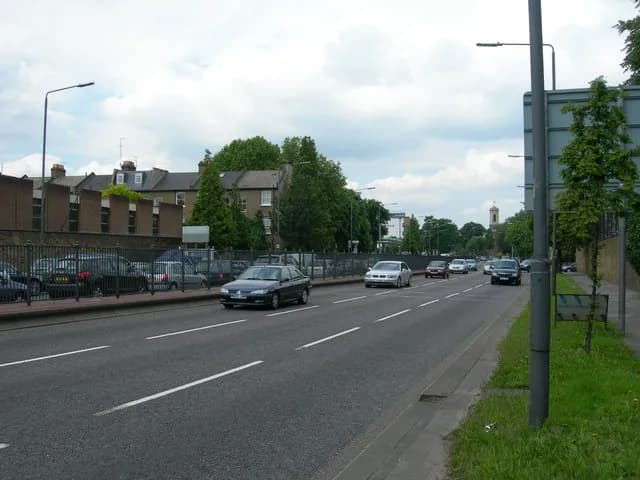
On 30 May 1925, King George V officially opened the Great West Road, a bypass designed to relieve congestion on Brentford High Street. This stretch of the A4 running west from Chiswick would soon become known as "The Golden Mile," transforming Hounslow into one of Britain's most important industrial corridors during the interwar period.
The road's development was strategically constrained; no commercial buildings could be constructed west of Syon Lane (Gillette Corner) because the land was owned by the Church Commissioners. This restriction concentrated industrial development along a clearly defined stretch, creating one of the most architecturally coherent industrial zones in the country.
American Investment and Art Deco Architecture
The Golden Mile attracted significant American investment during the late 1920s and 1930s. The first factory appeared in 1926 when Hudson-Essex Motors opened at number 970, manufacturing Hudson and Essex motor cars. The site became so well known that the Chiswick junction became commonly known as "Hudsons corner."
The arrival of the Firestone Tyre Company in 1928 marked a turning point. The factory, designed by the architectural practice Wallis, Gilbert and Partners, was the first overseas factory built by the American company. It established a design language that would define the Golden Mile: elaborate Art Deco façades fronting functional industrial spaces.
Wallis, Gilbert and Partners, founded by Thomas Wallis in 1916, became the dominant architectural force along the Golden Mile. Thomas Wallis described his approach as "Fancy" architecture, combining large, adaptable factory spaces behind elaborate Art Deco exteriors that served as effective advertising for the companies. He believed that good factory design positively affected workers, a progressive philosophy for the era.
The Golden Mile's Industrial Roster
Between 1926 and 1937, more than a dozen major factories appeared along this stretch. Smith's Potato Crisps opened in 1927, expanding in 1930 with a distinctive colonnaded frontage. The brand, now owned by PepsiCo, remains a household name.
The Trico Products windscreen wiper factory opened in 1928 at number 980, whilst Leonard Williams Ltd established Packard Cars operations in 1929. Pyrene Fire Extinguisher Company commissioned Wallis, Gilbert and Partners to design their building between 1929 and 1930. Jantzen Knitting Mills and Sperry Gyroscope Company both opened facilities in 1931.
1932 proved particularly productive: Coty Cosmetics commissioned Wallis, Gilbert and Partners for their factory at number 941, whilst Macleans established their toothpaste manufacturing operation. The latter brand, founded by Alex C Maclean in 1919 and famous for the slogan "Did you Maclean your teeth today?" was acquired by Beecham in 1938 and is now owned by GlaxoSmithKline.
The Gillette Factory, designed by Sir Banister Flight Fletcher and completed between 1936 and 1937, became the area's most recognisable landmark. Its 45-metre clocktower with an illuminated face guided traffic along the Great West Road for decades. Fletcher, who was knighted in 1919 and served as president of the Royal Institute of British Architects from 1929 to 1931, created a building that remains Grade II listed today.
Wallis House, built between 1936 and 1942 for Simmonds Aerocessories and also designed by Wallis, Gilbert and Partners, was named after architect Thomas Wallis. The Currys factory and head office at number 991, completed in 1936, is now Grade II listed and was restored by Foster and Partners between 1997 and 2000 for JCDecaux.
Wartime Contributions and Sacrifices
The factories played crucial roles during the Second World War. Many converted to wartime production, manufacturing aircraft parts, munitions, and military equipment. The Currys building, barely five years old, was requisitioned in 1941 under the Defence of the Realm Act's emergency provisions to accommodate an expanding aircraft parts company.
The area's strategic importance made it a target. In March 1945, a V2 rocket exploded at the Packard Cars site at number 971 Great West Road, a tragic reminder of the area's industrial significance during wartime.
Syon Lane railway station was constructed specifically to serve factory workers, demonstrating the scale of employment the Golden Mile generated. Thousands of local residents found work in these modern facilities, which represented a significant upgrade from the cramped Victorian industrial buildings they replaced.
The Controversial Loss of the Firestone Factory
The Golden Mile's architectural legacy suffered a devastating blow during the August 1980 bank holiday weekend when the Firestone Tyre Factory was demolished. The building was destroyed shortly before a preservation order was due to be served, preventing its Grade II listing.
The demolition has been credited with the foundation of the Thirties Society, which later became The Twentieth Century Society. The organisation describes the Firestone destruction as their "first serious case," stating that "its destruction focused public attention on the necessity for greater protection for 20th century buildings and led directly to the listing of 150 examples of inter-war architecture."
The remaining Firestone gates, railings, and piers, designed in the Jazz Modern style, were finally Grade II listed in 2001. However, the gatehouse was demolished in 2004, leaving only fragments of the original complex.
Transformation and Preservation
Several Golden Mile buildings have been successfully adapted for contemporary use. The Coty Cosmetics factory now operates as BMI Syon Clinic. Wallis House was converted to residential apartments by Assael Architecture between 2005 and 2008. The Gillette Factory ceased production in April 2006, with manufacturing relocating to Poland; the building is undergoing conversion into a mixed-use complex including a hotel and residential apartments.
Not all structures survived. The Trico factory was demolished after the company relocated to Pontypool in 1992; the site now houses GlaxoSmithKline headquarters. The Macleans factory was demolished in early 1997 after standing empty. The MacFarlane Biscuit Factory, located behind the Gillette building, was demolished in the 1980s; a Tesco supermarket and Sky headquarters now occupy the site. The Burgoynes Radio Factory was demolished in 1996, and the Jantzen Knitting Mills relocated in 1962; their site is now occupied by office towers housing Samsung Europe.
The Pyrene Building, now known as Westlink House, and Henly's Car Showroom (opened 1937 with its distinctive tower) are among the remaining structures that recall the Golden Mile's industrial past.
A Legacy of Progressive Design
The Golden Mile represented a revolution in British industrial architecture. Thomas Wallis's philosophy that factory design should provide both effective advertising and positive working environments challenged the utilitarian approach that had dominated Victorian industrial construction. His "Fancy" architecture created buildings that were functional yet beautiful, modern yet decorative.
Sir Banister Flight Fletcher's Gillette Factory demonstrated that industrial buildings could become genuine landmarks, its clocktower visible for miles along the Great West Road. The concentration of Art Deco industrial architecture along this single stretch of road made it unique in Britain.
The area's significance extends beyond architecture. The Golden Mile attracted American industrial investment at a time when Britain needed economic stimulus. It provided employment for generations of Hounslow residents. Its factories contributed to both World War efforts, sometimes at tragic cost.
What Remains Today
For Hounslow residents today, the Golden Mile's legacy is visible in the surviving Grade II listed buildings, the converted apartment blocks, and the continued commercial activity along the Great West Road. The Gillette clocktower, though no longer illuminated, remains a local landmark. The Currys building restoration by Foster and Partners demonstrated that inter-war industrial heritage can be successfully integrated into contemporary commercial use.
The story of the Golden Mile is ultimately a story of ambition: American companies seeking British markets, architects pursuing innovative industrial design, and a local community benefiting from modern employment opportunities. It is also a cautionary tale about heritage preservation, the loss of the Firestone Factory serving as a catalyst for improved protection of 20th-century architecture.
The Golden Mile may no longer manufacture motor cars, tyres, or toothpaste, but its contribution to Britain's industrial and architectural history remains significant.