A discovery made within the grounds of this Hounslow estate would eventually challenge the popular belief that Galileo Galilei was the first telescopic astronomer.
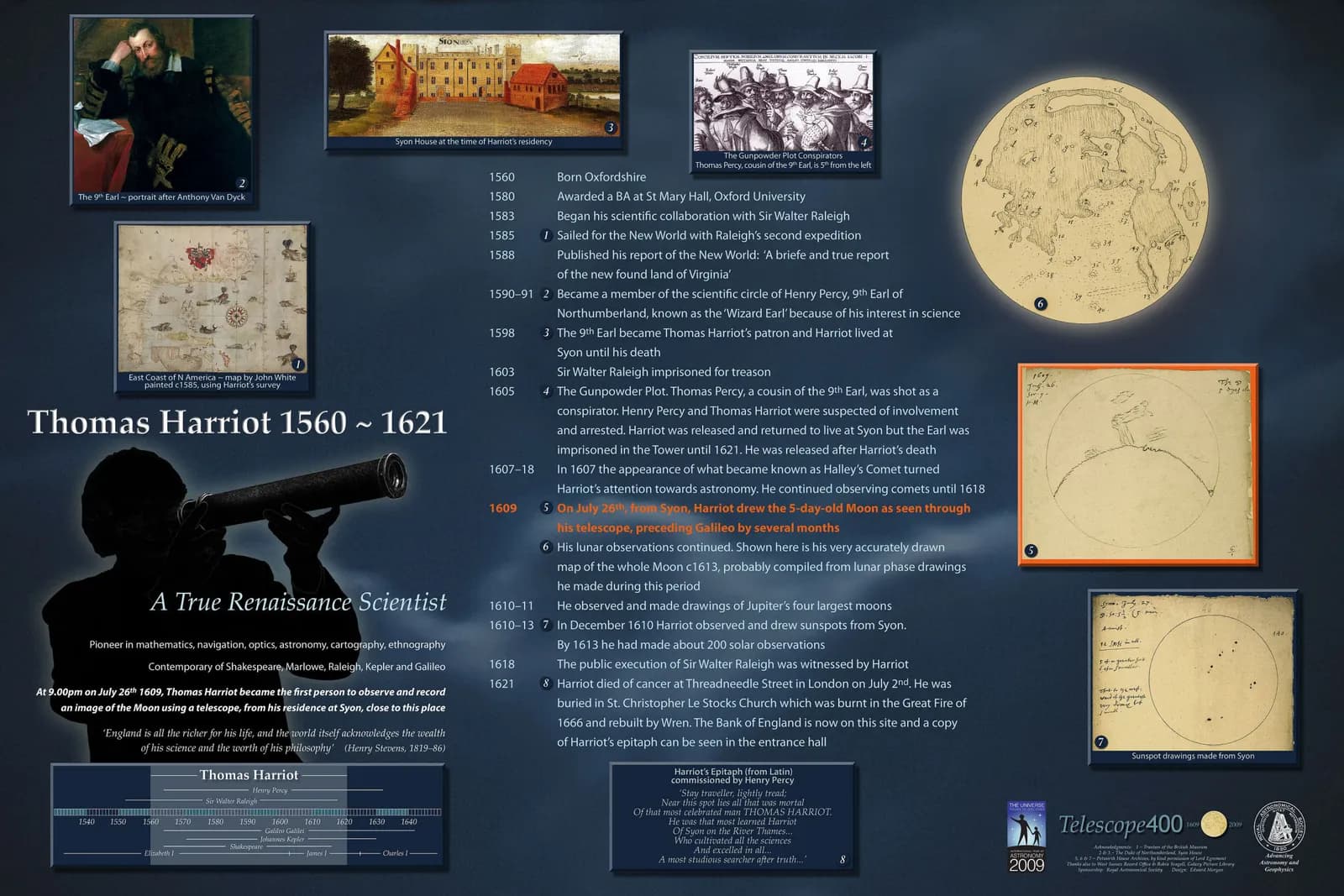
Four hundred years ago, a mathematician named Thomas Harriot stood in the grounds of Syon House in Brentford, trained a "Dutch trunke" telescope upon the Moon, and produced the first recorded telescopic astronomical observation in history. The date was 5 August 1609, Old Style, and it predates Galileo's famous observations by almost four months.
A Tudor Estate with Scientific Ambitions
Syon House sits in Syon Park within the London Borough of Hounslow, occupying a site that has witnessed nearly five centuries of English history. The house was constructed between 1547 and 1552 on the grounds of Syon Abbey, a former Bridgettine monastery. The estate passed through various hands before its acquisition in 1594 by Henry Percy, 9th Earl of Northumberland, whose family has owned it ever since.
The Percys transformed Syon into something more than an aristocratic residence. The 9th Earl, known as the "Wizard Earl" for his interest in alchemy and the sciences, created an environment where intellectual inquiry flourished. It was here that Thomas Harriot found patronage and a place to pursue his mathematical and astronomical studies.
Thomas Harriot: England's Forgotten Stargazer
Thomas Harriot was an English mathematician, astronomer and ethnographer who entered the service of Henry Percy in the 1590s. By 1609, he was residing at Syon House when news reached England of a remarkable optical device invented in the Netherlands.
The telescope had been invented in 1608, and Harriot acquired one of these early instruments, described as a "Dutch trunke," in early 1609. It offered approximately six times magnification. On the evening of 5 August 1609, using the Old Style calendar then in use (equivalent to 26 July in the modern calendar), Harriot made his historic observation.
He sketched what he saw: the rough, cratered surface of the Moon. This drawing is now recognised as the first recorded telescopic observation of an astronomical object ever made. Harriot would continue his observations, becoming the first person to observe sunspots with a telescope in December 1610, and by 1613 he had produced two remarkably accurate maps of the entire Moon.
Why Harriot's Discovery Was Forgotten
Galileo Galilei made his first telescopic observations on 30 November 1609, nearly four months after Harriot. Yet while Galileo published his findings in 1610 in his book Sidereus Nuncius, complete with detailed illustrations of lunar mountains and craters, Harriot kept his work private.
The reasons for this silence may lie in the political turbulence of the time. In 1605, Harriot's patron, the 9th Earl of Northumberland, had been imprisoned in the Tower of London for his connection to Thomas Percy, a Gunpowder Plot conspirator. The Earl remained imprisoned until 1621, and it is thought that Harriot's caution in publishing was linked to this association.
Harriot's lunar drawings were not published until 1784, and some of his work only came to light as late as 1965. By then, Galileo had long been established in popular imagination as the pioneer of telescopic astronomy.
The Commemoration at Syon House
On 26 July 2009, exactly 400 years after Harriot's first observation, a memorial plaque was unveiled at Syon House by Lord Egremont. The ceremony formed part of the International Year of Astronomy and was sponsored by the Royal Astronomical Society. Visitors to the estate today can view this plaque, which stands "not far from where the observations took place."
The estate remains open to the public from mid-March to the end of October. The house itself contains interiors designed by Robert Adam in the 1760s, while the grounds feature a Great Conservatory completed in 1827 and parkland laid out by Capability Brown. The Thomas Harriot memorial plaque offers a quiet reminder that Hounslow played a role in one of the most significant moments in astronomical history.
The Telescope That Started It All
Harriot's "Dutch trunke" was a simple instrument compared to modern telescopes, yet it opened a new era in human understanding of the cosmos. The telescope had been invented in the Netherlands the previous year, and news of the device spread quickly across Europe. Harriot's early adoption of the technology and his scientific approach to observation place him among the most significant figures in the history of astronomy, even if his name remains less familiar than Galileo's.
For residents of Hounslow, Syon House offers more than architectural grandeur and landscaped gardens. It stands as the site where an English scientist, working quietly in the grounds of a Tudor estate, became the first human being to see the Moon through a telescope. The view he captured that August evening in 1609 marked the beginning of a new age of discovery.