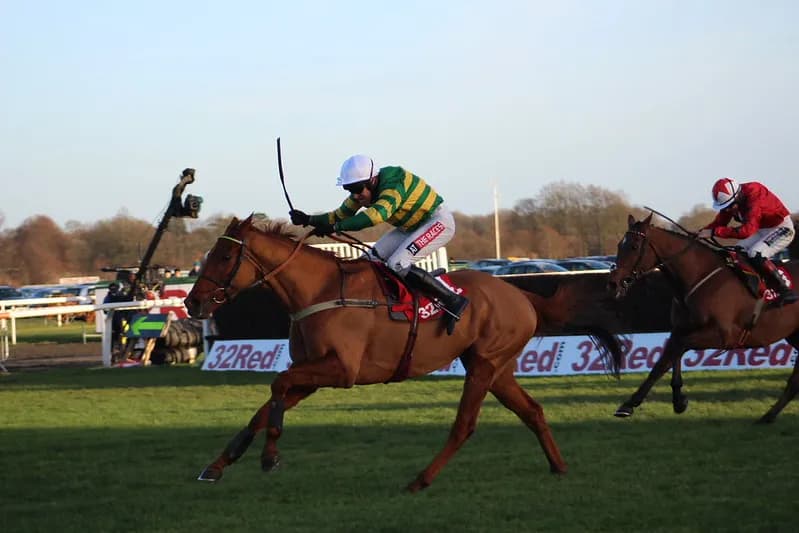
Leave work in Hounslow on an October afternoon and you can still be at the races before the evening is properly under way.
That is one of Kempton Park's great advantages.
The racecourse sits just beyond Feltham and Hanworth in Sunbury-on-Thames, close enough for an evening trip without having to turn it into a full day out.
And October is particularly busy.
Eight floodlit Flat meetings are scheduled during the month, beginning on Monday 5th October, while Kempton is also hoping to open its new jumps season on Sunday 18th October.
There is one important caveat for that Sunday fixture.
After the exceptionally dry weather, the Jockey Club said on 2nd October that the ground was not currently fit for jump racing. No decision has yet been made on whether the meeting can go ahead at Kempton, so anyone planning to attend should check for an update before travelling.
The floodlit all-weather racing is unaffected.
Eight evenings under the lights
Kempton's October Flat programme is:
Monday 5th October
Wednesday 7th October
Friday 9th October
Monday 12th October
Wednesday 14th October
Wednesday 21st October
Monday 26th October
Wednesday 28th October
Then there is CopyBet Jump Sunday on 18th October, subject to the ground being suitable.
That makes Kempton particularly useful for Hounslow racegoers.
This is not racing that requires taking a whole day off work. The floodlit meetings run into the evening and the racecourse has its own railway station immediately beside the track.
On Monday 5th October, for example, racing continues until around 8.30pm.
It is quite possible to arrive after the working day has already started to disappear behind you.
How Kempton ended up here
Kempton Park's racing story began almost 150 years ago.
Samuel H Hyde acquired Kempton Manor and its grounds in 1872 with the ambition of creating a racecourse.
The first meeting was held on 18th July 1878.
The railway was an important part of the idea from the beginning and Kempton Park station opened alongside the course, giving London racegoers direct access to the track.
Kempton has changed considerably since then.
Its modern identity comes from being two racecourses in one.
There is the turf course used for jump racing, including one of the great fixtures of the British sporting Christmas, the King George VI Chase on Boxing Day.
Inside it sits the floodlit all-weather course which provides racing throughout much of the year.
That track arrived after Kempton closed for redevelopment in May 2005.
Eleven months later it reopened with its new all-weather surface and floodlights.
The result was a racecourse that no longer had to wait for Saturday afternoon.
Wednesday night in October could become a raceday too.
The horses that made Kempton famous
For all the evening Flat racing, Kempton's most famous stories have been written over fences.
The King George VI Chase was first run in 1937 and has become one of Britain's major jump races.
Two horses in particular dominate its history.
Desert Orchid won four King Georges, in 1986, 1988, 1989 and 1990.
The popular grey became so closely associated with Kempton that his ashes were eventually buried at the racecourse, close to the statue that commemorates him.
Then came Kauto Star.
Between 2006 and 2011 he won the King George five times, setting a record that still stands.
That history is why the proposed return of jump racing on Sunday 18th October matters.
It is supposed to be the first Kempton jump meeting of the 2026/27 season and the beginning of the road towards Boxing Day.
The weather may yet have other ideas.
A course designed for evening racing
Kempton's all-weather track is right-handed and relatively flat.
It has two loops, which means not every race follows exactly the same shape.
Shorter races can be quite sharp, rewarding horses able to secure a good position before the home straight.
Longer races give runners more time to settle and build momentum.
But for a first visit, none of that needs to matter too much.
One of the pleasures of a quieter evening meeting is simply being able to move around.
Watch the horses in the parade ring before a race, walk towards the track as the jockeys head out and find somewhere close to the finish.
There is no need to bet on every race, or indeed any of them.
For someone trying racing for the first time, an evening at Kempton can be as much about the horses, atmosphere and spectacle as studying form.
And unlike some major racedays, there is little pressure to dress for an occasion.
October evenings are more likely to reward a warm coat and comfortable shoes.
Hounslow and the land around Kempton
The connection with Hounslow goes beyond the simple fact that Kempton is nearby.
This part of west London and Middlesex has a remarkable history of its own.
Hounslow Heath once stretched across thousands of acres.
For centuries it was crossed by travellers heading west from London and became notorious for highwaymen targeting coaches on the Bath Road.
But one of its most important stories involves something rather more scientific.
In 1784, Major General William Roy chose the flat ground of Hounslow Heath for an extraordinarily precise measurement.
He established a baseline more than five miles long as part of work to connect the observatories at Greenwich and Paris.
That measurement would become an important foundation for the surveying of Britain and the eventual development of the Ordnance Survey.
The line ran between what is now the Heathrow area and Hampton, with its south-eastern end close to Kempton.
A cannon set into the ground at Roy Grove in Hampton still marks that end of the baseline.
From maps to aeroplanes
Hounslow Heath later found itself at the beginning of another journey.
An aerodrome developed there during the early twentieth century and became one of Britain's pioneering aviation sites.
In 1919, Ross and Keith Smith left Hounslow in a Vickers Vimy aircraft with mechanics Jim Bennett and Wally Shiers.
Their destination was Australia.
They reached Darwin after an extraordinary flight and won the £10,000 prize offered by the Australian government for the achievement.
The first successful flight from Britain to Australia had begun on Hounslow Heath.
Today most of the old heath has disappeared beneath roads, housing and Heathrow, but around 200 acres survive as Hounslow Heath Local Nature Reserve.
It is another reminder of how much history sits beneath this otherwise familiar stretch of west London.
Making more of an evening out
Kempton's proximity makes it easy to combine racing with somewhere closer to home.
Osterley Park is one of Hounslow's grandest spaces, with its Robert Adam-designed house surrounded by parkland.
There is also Boston Manor House in Brentford, Gunnersbury Park, Syon Park and the open ground around Hounslow Heath itself.
But Kempton does not really require an elaborate itinerary.
That is arguably its attraction.
For many Hounslow residents, this is racing you can decide to attend without planning a weekend around it.
Finish work.
Head towards Sunbury.
Watch the horses under the floodlights.
Then come home.
Kempton Park stages floodlit Flat racing on 5th, 7th, 9th, 12th, 14th, 21st, 26th and 28th October.
Jump Sunday is currently scheduled for 18th October, but racegoers should check the latest position before travelling because of the continuing dry-ground concerns.
Kempton Park Racecourse is on Staines Road East in Sunbury-on-Thames, less than a mile from junction 1 of the M3. Kempton Park station is around 200 yards from the racecourse entrance.
Check the racecourse website before travelling for confirmed race times, tickets and any updates affecting the 18th October jumps fixture.